Cybersecurity Threats Every Business Must Know in 2026
Discover the 8 critical cybersecurity threats facing businesses in 2026, from AI-powered attacks to cloud misconfigurations, plus actionable defense strategies to protect your organization.

Arman Ali
I specialize in building and maintaining scalable web applications, with a strong focus on performance, user experience, and backend efficiency. With over 4+ years of experience, I have evolved from a front-end expert into a full-stack developer proficient in both front-end and back-end development.
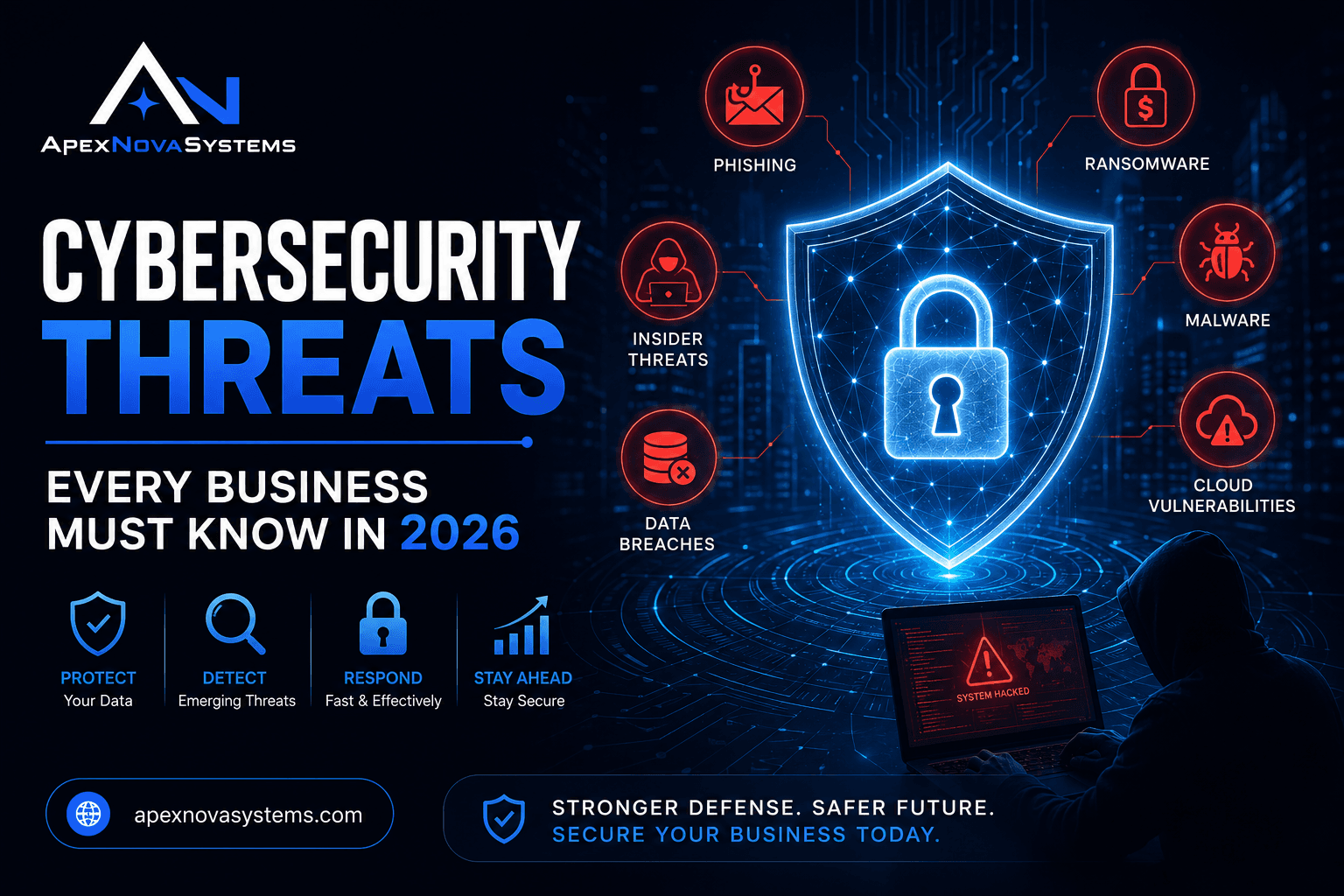
As we navigate through 2026, the cybersecurity landscape continues to evolve at an unprecedented pace. Businesses of all sizes face increasingly sophisticated threats that can disrupt operations, compromise sensitive data, and damage reputations. Understanding these threats is the first step toward building a resilient security posture.
1. AI-Powered Cyberattacks
Artificial intelligence has become a double-edged sword in cybersecurity. While organizations leverage AI for defense, threat actors are using machine learning to craft more convincing phishing campaigns, automate vulnerability discovery, and evade traditional detection systems.
Key concerns:
- Deepfake technology used in business email compromise (BEC) attacks
- AI-generated malware that adapts to security environments
- Automated reconnaissance and exploitation at scale
- Sophisticated social engineering powered by large language models
Mitigation strategies:
- Implement AI-powered security tools for threat detection
- Establish multi-factor authentication (MFA) with biometric verification
- Train employees to recognize AI-generated content
- Deploy behavioral analysis systems to detect anomalous activities
2. Supply Chain Vulnerabilities
Third-party software and service providers remain prime targets for attackers seeking to compromise multiple organizations simultaneously. A single breach in a widely-used component can cascade across thousands of businesses.
Common attack vectors:
- Compromised software updates and patches
- Malicious code injected into open-source libraries
- Vendor access credentials exploitation
- Cloud service provider vulnerabilities
Protection measures:
- Conduct thorough vendor security assessments
- Implement zero-trust architecture for third-party access
- Monitor software dependencies and maintain an up-to-date inventory
- Use software composition analysis (SCA) tools
- Establish incident response protocols with suppliers
3. Ransomware-as-a-Service (RaaS)
Ransomware attacks have become more accessible through RaaS platforms, enabling even less technically skilled criminals to launch devastating attacks. Modern ransomware often includes data exfiltration, threatening to leak sensitive information if ransom demands aren't met.
Emerging trends:
- Double and triple extortion tactics
- Targeting of critical infrastructure and healthcare
- Ransomware targeting cloud environments and containers
- Longer dwell times before encryption to maximize damage
Defense tactics:
- Maintain offline, encrypted backups with regular testing
- Implement network segmentation to limit lateral movement
- Deploy endpoint detection and response (EDR) solutions
- Conduct regular security awareness training
- Develop and test incident response and disaster recovery plans
4. IoT and Edge Device Exploitation
The proliferation of Internet of Things (IoT) devices and edge computing infrastructure has expanded the attack surface dramatically. Many of these devices lack robust security features and receive infrequent updates.
Vulnerabilities include:
- Default or weak credentials on industrial IoT devices
- Unpatched firmware in connected equipment
- Insufficient network segmentation for IoT environments
- Limited visibility into device behavior and communications
Best practices:
- Inventory all connected devices and their security status
- Change default credentials and enforce strong password policies
- Isolate IoT devices on separate network segments
- Implement device authentication and encryption protocols
- Establish a patch management program for all connected assets
5. Cloud Security Misconfigurations
As organizations accelerate cloud adoption, misconfigurations remain one of the leading causes of data breaches. The complexity of multi-cloud environments and the shared responsibility model often create security gaps.
Common mistakes:
- Publicly accessible storage buckets with sensitive data
- Overly permissive identity and access management (IAM) policies
- Disabled logging and monitoring features
- Unencrypted data in transit and at rest
- Shadow IT and unmanaged cloud services
Preventive measures:
- Use cloud security posture management (CSPM) tools
- Implement infrastructure-as-code with security scanning
- Enforce least privilege access principles
- Enable comprehensive logging and monitoring
- Conduct regular cloud security audits and compliance checks
6. Insider Threats
Whether malicious or accidental, insider threats pose significant risks. Employees, contractors, and partners with legitimate access can cause substantial damage through data theft, sabotage, or unintentional security lapses.
Risk factors:
- Disgruntled employees with elevated privileges
- Negligent handling of credentials and sensitive information
- Lack of access controls and monitoring
- Insufficient offboarding procedures
Mitigation approaches:
- Implement user and entity behavior analytics (UEBA)
- Enforce principle of least privilege access
- Monitor and audit privileged user activities
- Conduct background checks for sensitive positions
- Establish clear security policies and acceptable use guidelines
- Create a culture of security awareness and reporting
7. Advanced Persistent Threats (APTs)
Nation-state actors and sophisticated criminal organizations conduct long-term, targeted campaigns designed to steal intellectual property, disrupt operations, or gather intelligence. These threats are characterized by stealth, persistence, and significant resources.
Characteristics:
- Custom malware and zero-day exploits
- Living-off-the-land techniques using legitimate system tools
- Encrypted command and control communications
- Multi-stage attacks with careful operational security
Defense strategies:
- Deploy advanced threat detection with threat intelligence feeds
- Conduct regular penetration testing and red team exercises
- Implement network traffic analysis and anomaly detection
- Maintain robust logging for forensic investigation
- Develop relationships with industry information sharing groups
8. Mobile Device Threats
Mobile devices continue to be attractive targets as they often contain sensitive business data and serve as entry points to corporate networks. The bring-your-own-device (BYOD) trend increases these risks.
Mobile-specific threats:
- Malicious applications and app store trojans
- Mobile phishing (smishing) and vishing attacks
- Unsecured Wi-Fi connections and man-in-the-middle attacks
- Device loss or theft
- Operating system and application vulnerabilities
Security controls:
- Implement mobile device management (MDM) or unified endpoint management (UEM)
- Enforce encryption for data at rest and in transit
- Require VPN for accessing corporate resources
- Enable remote wipe capabilities
- Educate users about mobile security risks
Building a Comprehensive Security Strategy
Addressing these threats requires a multi-layered approach that combines technology, processes, and people. Key components of an effective cybersecurity strategy include:
- Risk Assessment: Regularly evaluate your organization's threat landscape and vulnerabilities
- Security Framework: Adopt standards like NIST, ISO 27001, or CIS Controls
- Defense in Depth: Implement multiple layers of security controls
- Continuous Monitoring: Deploy 24/7 security operations center (SOC) capabilities
- Incident Response: Maintain an updated and tested incident response plan
- Security Awareness: Invest in ongoing employee training and simulations
- Compliance: Ensure adherence to relevant regulations and industry standards
- Cyber Insurance: Consider coverage as part of risk management strategy
Conclusion
The cybersecurity threat landscape in 2026 demands vigilance, investment, and a proactive security mindset. While the threats are significant, organizations that prioritize security, stay informed about emerging risks, and implement comprehensive defense strategies can significantly reduce their exposure.
Remember that cybersecurity is not a one-time project but an ongoing journey. Regular assessments, continuous improvement, and adaptation to new threats are essential for protecting your business in an increasingly connected and complex digital environment.
By understanding these critical threats and taking decisive action, businesses can build resilience and maintain the trust of customers, partners, and stakeholders in the face of evolving cyber risks.
Written by
Arman Ali
I specialize in building and maintaining scalable web applications, with a strong focus on performance, user experience, and backend efficiency. With over 4+ years of experience, I have evolved from a front-end expert into a full-stack developer proficient in both front-end and back-end development.
Discussion(0)
Sign in to comment with your account, or fill in your name below as a guest.
Continue reading
Browse all → Engineering
When AI Agents Make Mistakes: The New Reality of Autonomous Systems in the Workplace
As AI systems evolve from chatbots to autonomous agents, organizations must prepare for inevitable mistakes. Learn how to build resilient systems that can fail safely and recover quickly.
Arman Ali
Jul 21, 2026
 Engineering
Why We Built Our Own PDF Toolkit In-House — And Made It Free
Free, browser-based PDF tools built with privacy first. No ads, no uploads to unknown servers, no paywalls. Convert, merge, compress, and edit PDFs—plus AI-powered summaries.
Zeeshan
Jul 8, 2026
 Engineering
How Much Does It Cost to Build a SaaS in 2026?
Discover the complete cost breakdown for building a SaaS product in 2026, from $50K MVPs to $1M+ enterprise platforms. Learn budgeting strategies and cost-saving tips.
ApexNova Admin
Jul 7, 2026