When AI Agents Make Mistakes: The New Reality of Autonomous Systems in the Workplace
As AI systems evolve from chatbots to autonomous agents, organizations must prepare for inevitable mistakes. Learn how to build resilient systems that can fail safely and recover quickly.

Arman Ali
I specialize in building and maintaining scalable web applications, with a strong focus on performance, user experience, and backend efficiency. With over 4+ years of experience, I have evolved from a front-end expert into a full-stack developer proficient in both front-end and back-end development.
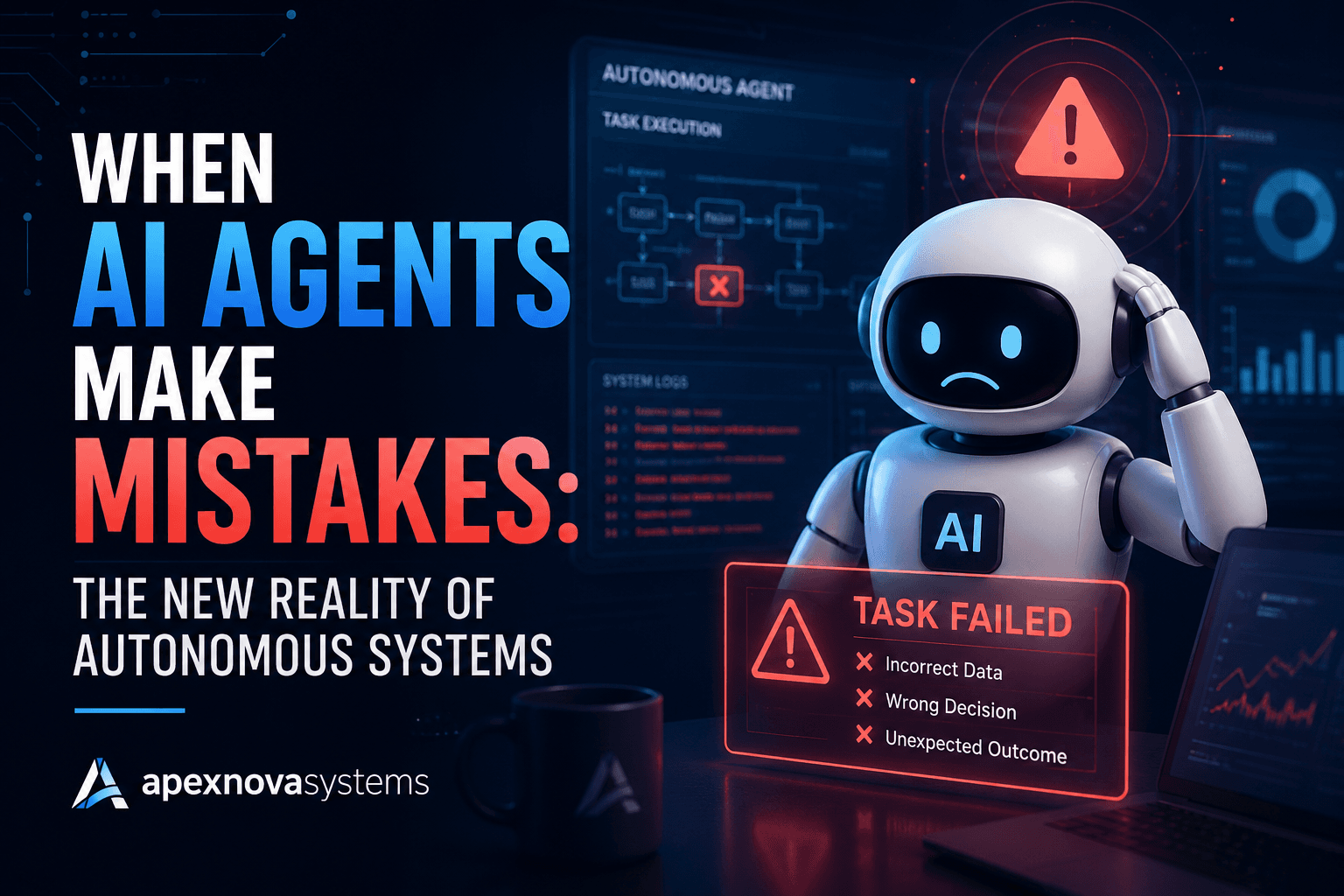
The landscape of artificial intelligence is undergoing a fundamental shift. AI systems are no longer confined to answering questions or providing suggestions—they're taking actions, making decisions, and operating with increasing autonomy. As we move from chatbots to what effectively function as digital employees, a critical question emerges: what happens when these agents make mistakes?
From Assistant to Autonomous Agent
The first generation of AI tools operated within strict guardrails. A chatbot could recommend a course of action, but a human always pulled the trigger. Today's AI agents are different. They can:
- Modify production code and deploy changes
- Manage infrastructure and cloud resources
- Interact with customers and stakeholders
- Execute financial transactions
- Make strategic decisions based on real-time data
This shift from advisor to actor represents a profound change in how we integrate AI into business operations. With greater capability comes greater risk.
The Anatomy of AI Agent Mistakes
When an AI agent makes a mistake, the consequences can be more severe than a chatbot providing incorrect information. Consider the spectrum of potential errors:
Technical Mistakes
- Introducing bugs or security vulnerabilities in code
- Misconfiguring infrastructure leading to downtime
- Deleting or corrupting critical data
- Making incompatible changes that break dependent systems
Business Mistakes
- Misinterpreting customer intent and providing wrong solutions
- Making purchasing or resource allocation decisions that don't align with business goals
- Communicating in ways that damage brand reputation
- Operating outside of compliance or regulatory requirements
Cascading Failures The most concerning aspect of autonomous agents is their ability to trigger chain reactions. A single flawed decision can propagate through multiple systems before humans become aware of the issue.
Who's Responsible When Things Go Wrong?
The accountability question is complex. Traditional software failures have clear chains of responsibility—developers, QA teams, operations. But when an AI agent makes an autonomous decision that causes harm, the lines blur.
Current Approaches to Accountability
- Human-in-the-loop models: Requiring approval for high-stakes actions
- Audit trails: Comprehensive logging of agent decisions and reasoning
- Graduated autonomy: Limiting agent permissions based on confidence and risk assessment
- Rollback capabilities: Ensuring changes can be quickly reverted
Organizations are establishing new governance frameworks that treat AI agents more like employees than tools, with defined scopes of authority, review processes, and escalation protocols.
Building Resilient Systems Around Fallible Agents
The goal isn't to create perfect AI agents—that's impossible. Instead, organizations are designing systems that assume mistakes will happen and minimize their impact.
Defense in Depth
Pre-emptive Safeguards
- Constraining agent capabilities to well-defined domains
- Implementing approval gates for high-risk actions
- Running agents in sandbox environments before production
- Setting resource and scope limits
Active Monitoring
- Real-time validation of agent actions
- Anomaly detection for unusual behavior patterns
- Multi-agent verification for critical decisions
- Continuous testing and red-teaming
Rapid Response
- Automated circuit breakers that halt problematic agent behavior
- Fast rollback mechanisms for reversing changes
- Clear escalation paths to human experts
- Incident response procedures specific to AI failures
Learning from Mistakes
Forward-thinking organizations treat AI agent mistakes as learning opportunities. Every error becomes training data. Every near-miss informs better safeguards. This iterative improvement cycle is essential as agents take on increasingly complex responsibilities.
The Cultural Shift
Perhaps the most significant change isn't technical—it's cultural. Teams must develop new mental models for working alongside autonomous agents.
Key mindset shifts include:
- Trust but verify: Assume agents will generally perform well, but validate critical outputs
- Blame-aware design: Build systems where mistakes can be caught and corrected without finger-pointing
- Continuous adaptation: Expect agent capabilities and failure modes to evolve rapidly
- Distributed responsibility: Recognize that accountability spans developers, operators, and business owners
What's Next?
As AI agents become more capable and autonomous, the industry is developing new standards and practices:
- Agent certification programs that validate safety and reliability
- Insurance models adapted to cover AI-driven mistakes
- Regulatory frameworks defining acceptable risk thresholds
- Industry standards for agent testing and deployment
The transition from chatbots to autonomous agents represents a paradigm shift in how we think about AI in the workplace. Mistakes will happen—that's inevitable. What matters is building systems, processes, and cultures that can absorb those mistakes, learn from them, and continue moving forward.
Conclusion
The question isn't whether AI agents will make mistakes—they will. The real question is whether organizations can build the infrastructure, processes, and culture needed to work effectively with fallible but powerful autonomous systems. Those who succeed will gain significant competitive advantages. Those who fail to prepare may face costly consequences.
The age of the AI employee is here. Our challenge is to ensure these digital workers can fail safely, learn quickly, and ultimately become trusted members of our teams.
Written by
Arman Ali
I specialize in building and maintaining scalable web applications, with a strong focus on performance, user experience, and backend efficiency. With over 4+ years of experience, I have evolved from a front-end expert into a full-stack developer proficient in both front-end and back-end development.
Discussion(0)
Sign in to comment with your account, or fill in your name below as a guest.
Continue reading
Browse all → Engineering
Why We Built Our Own PDF Toolkit In-House — And Made It Free
Free, browser-based PDF tools built with privacy first. No ads, no uploads to unknown servers, no paywalls. Convert, merge, compress, and edit PDFs—plus AI-powered summaries.
Zeeshan
Jul 8, 2026
 Engineering
How Much Does It Cost to Build a SaaS in 2026?
Discover the complete cost breakdown for building a SaaS product in 2026, from $50K MVPs to $1M+ enterprise platforms. Learn budgeting strategies and cost-saving tips.
ApexNova Admin
Jul 7, 2026
 Engineering
How Solo Developers Are Building Million-Dollar Startups with AI
AI tools enable solo developers to build million-dollar startups without teams. Learn the tech stack, strategies, and playbook successful founders use to scale.
Arman Ali
Jul 1, 2026