How Solo Developers Are Building Million-Dollar Startups with AI
AI tools enable solo developers to build million-dollar startups without teams. Learn the tech stack, strategies, and playbook successful founders use to scale.

Arman Ali
I specialize in building and maintaining scalable web applications, with a strong focus on performance, user experience, and backend efficiency. With over 4+ years of experience, I have evolved from a front-end expert into a full-stack developer proficient in both front-end and back-end development.
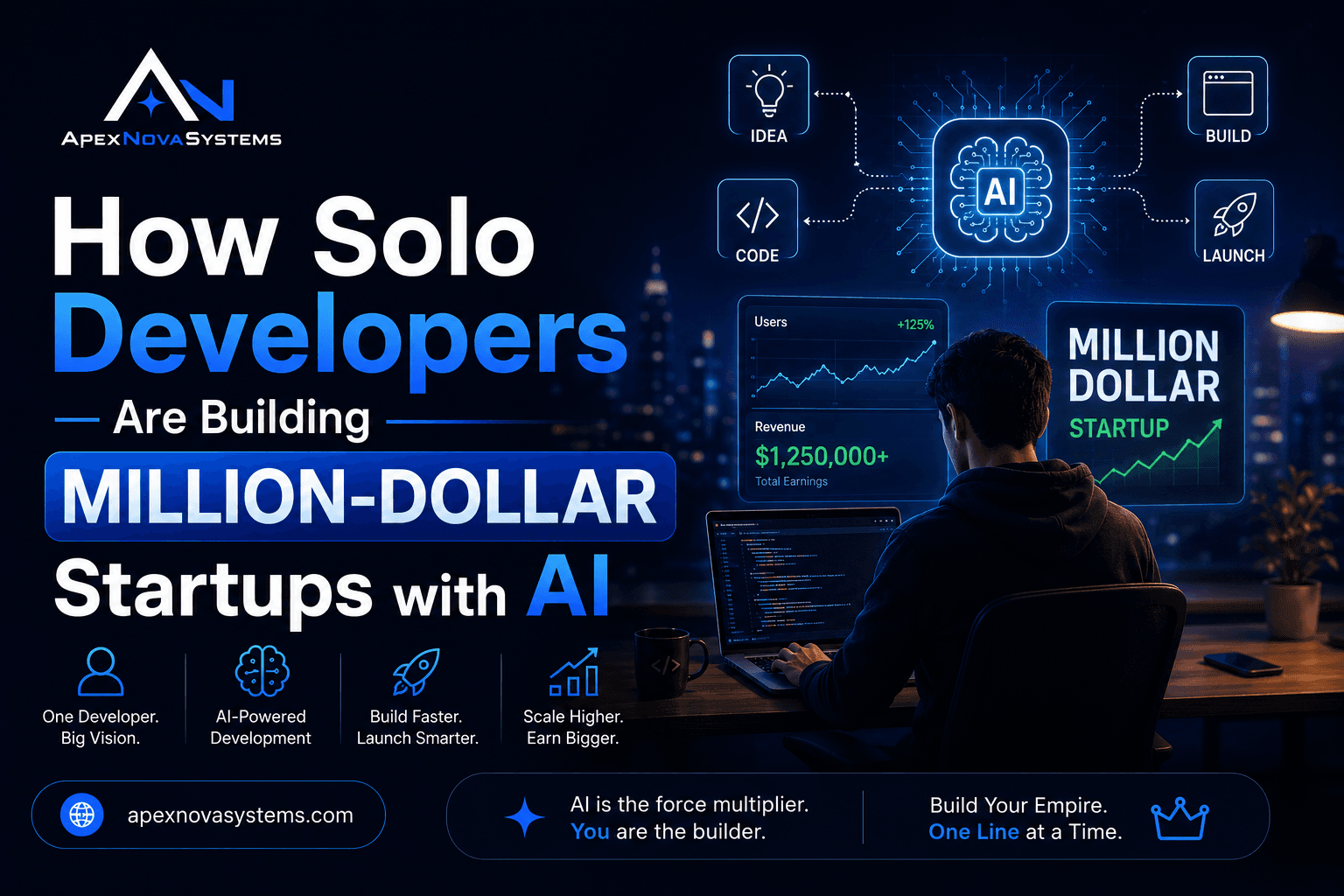
The startup landscape is undergoing a seismic shift. Where founding teams once required a full roster of engineers, designers, marketers, and salespeople, today's solo developers are leveraging AI to build, launch, and scale million-dollar businesses entirely on their own. This isn't just theory—it's happening right now, and the playbook is becoming increasingly clear.
The New Reality: One Person, Many Capabilities
AI tools have effectively compressed what used to require a full team into a set of accessible capabilities for a single developer. The modern solo founder can now:
- Design interfaces using AI-powered design tools and generate production-ready UI components
- Write and optimize code across multiple languages and frameworks with AI pair programming
- Create marketing content including blog posts, social media copy, and email campaigns
- Handle customer support with AI chatbots that learn from interactions
- Analyze data and metrics using natural language queries and automated insights
- Manage operations through intelligent automation and workflow tools
This isn't about replacing human creativity or decision-making—it's about augmenting a developer's capabilities to handle the full spectrum of business needs.
The Million-Dollar Solo Stack
Successful solo developers are converging on a similar technology stack that enables them to punch above their weight:
Development and Infrastructure
- AI code assistants (GitHub Copilot, Cursor, v0) for rapid development and debugging
- Serverless architectures to minimize DevOps overhead
- Low-code/no-code backends for common functionality (auth, payments, databases)
- AI-generated APIs and microservices for complex integrations
Product and Design
- AI design tools for creating mockups and user interfaces
- Component libraries augmented with AI customization
- Automated testing powered by AI to catch edge cases
- User analytics with AI-driven insights into behavior patterns
Marketing and Growth
- AI content generation for SEO-optimized blog posts and landing pages
- Automated social media management with intelligent scheduling and engagement
- Email marketing platforms with AI-powered personalization
- Ad campaign optimization using machine learning algorithms
Operations and Support
- AI customer service handling tier-1 support automatically
- Automated workflows for billing, onboarding, and retention
- Intelligent monitoring that predicts and prevents issues
- Financial management with AI-powered bookkeeping and forecasting
Real Success Patterns Emerging
The solo developers hitting seven-figure revenues share common characteristics and strategies:
1. Niche Focus with Broad Application
They start with a specific problem in a well-defined niche but build solutions with extensible architectures. The initial product is laser-focused, but the underlying platform can expand horizontally.
2. API-First Architecture
By building API-first, they enable both their own AI tools and customers to integrate programmatically. This creates compound growth opportunities and reduces manual work.
3. AI as Product, Not Just Tool
The most successful solo founders don't just use AI to build faster—they embed AI capabilities directly into their products, creating unique value propositions that would be impossible for traditional competitors to replicate quickly.
4. Community-Driven Development
They leverage AI to maintain active communities at scale, using automated moderation, personalized responses, and intelligent content curation to build engaged user bases without human overhead.
5. Ruthless Automation
Every repetitive task is automated. If something needs to be done more than twice, they build or find an AI tool to handle it. This discipline is what allows a single person to serve thousands of customers.
The Economics Are Compelling
The financial advantages of the AI-augmented solo developer model are striking:
Traditional SaaS Startup:
- Team of 5-8 people
- $50K-$80K monthly burn rate
- 12-18 months to product-market fit
- $500K-$2M raised to reach profitability
AI-Powered Solo Developer:
- One person
- $500-$2K monthly expenses
- 3-6 months to product-market fit
- Often bootstrapped to profitability
This means solo developers can afford to:
- Take more creative risks
- Iterate faster based on market feedback
- Maintain full ownership and control
- Achieve profitability at much lower revenue thresholds
- Build sustainable lifestyle businesses or scale to large ventures
The Skills That Matter Now
The skills required for solo success have evolved. Technical ability remains important, but the differentiators are:
Product Sense
Understanding what customers need and translating that into features. AI can build anything you specify—the challenge is knowing what to build.
Systems Thinking
Architecting solutions where AI tools, APIs, and automation work together seamlessly. The best solo developers are orchestrators, not just coders.
Rapid Learning
New AI tools and capabilities emerge constantly. Success requires staying current and quickly integrating new technologies into existing workflows.
Customer Empathy
With AI handling execution, the competitive advantage shifts to understanding customers deeply and building solutions that truly resonate.
Strategic Patience
Knowing when to automate, when to do things manually, and when to invest in custom solutions versus using existing tools. This judgment call separates successful solo founders from those who get bogged down.
Challenges and Considerations
The solo AI-powered path isn't without challenges:
Loneliness and Decision Fatigue: Every decision rests on your shoulders. Building support networks and having trusted advisors becomes critical.
Quality Control: AI can generate vast amounts of work quickly, but ensuring quality requires human oversight and taste.
Scaling Limitations: At some point, certain businesses need human teams. Understanding that inflection point is important.
AI Dependency Risk: Over-reliance on specific AI tools creates vulnerability if those services change pricing, capabilities, or availability.
Customer Expectations: Users now expect 24/7 availability and instant responses, which requires sophisticated automation to maintain without burning out.
Looking Forward: The Next Wave
We're still in the early innings of this transformation. The next generation of solo-built companies will likely:
- Leverage AI agents that can autonomously handle complex, multi-step workflows
- Build voice and video products as easily as text-based ones today
- Create personalized experiences at a per-user level that were previously impossible
- Enter regulated industries using AI compliance and documentation tools
- Manage global operations including international compliance, localization, and support
The barrier isn't technical capability anymore—it's imagination and execution.
Getting Started: A Practical Roadmap
For developers considering the solo AI-powered path:
Month 1-2: Foundation
- Identify a specific problem you can solve
- Build an MVP using AI coding assistants
- Set up core infrastructure (hosting, domain, analytics)
- Create basic marketing site with AI-generated content
Month 3-4: Validation
- Launch to early adopters
- Use AI to analyze feedback and usage patterns
- Iterate rapidly on core features
- Set up automated customer support
Month 5-6: Growth
- Implement AI-powered marketing automation
- Build referral and viral loops
- Optimize conversion funnels with AI insights
- Automate operations and billing
Month 7-12: Scale
- Expand feature set based on data
- Build integrations and partnerships
- Implement advanced AI product features
- Consider strategic hiring or staying solo
The Bottom Line
AI hasn't just made it possible for solo developers to compete with teams—in many cases, it's given them distinct advantages. Lower overhead, faster iteration cycles, and the ability to stay close to customers create opportunities that traditional venture-backed startups struggle to match.
The million-dollar solo developer isn't a rare anomaly anymore. It's becoming a viable and increasingly common path for technical founders who understand how to leverage AI effectively. The question isn't whether this model works—it's whether you're ready to take advantage of it.
The tools are available. The playbook is emerging. The opportunity is now. The only question left is: what will you build?
Written by
Arman Ali
I specialize in building and maintaining scalable web applications, with a strong focus on performance, user experience, and backend efficiency. With over 4+ years of experience, I have evolved from a front-end expert into a full-stack developer proficient in both front-end and back-end development.
Discussion(0)
Sign in to comment with your account, or fill in your name below as a guest.
Continue reading
Browse all → Engineering
When AI Agents Make Mistakes: The New Reality of Autonomous Systems in the Workplace
As AI systems evolve from chatbots to autonomous agents, organizations must prepare for inevitable mistakes. Learn how to build resilient systems that can fail safely and recover quickly.
Arman Ali
Jul 21, 2026
 Engineering
Why We Built Our Own PDF Toolkit In-House — And Made It Free
Free, browser-based PDF tools built with privacy first. No ads, no uploads to unknown servers, no paywalls. Convert, merge, compress, and edit PDFs—plus AI-powered summaries.
Zeeshan
Jul 8, 2026
 Engineering
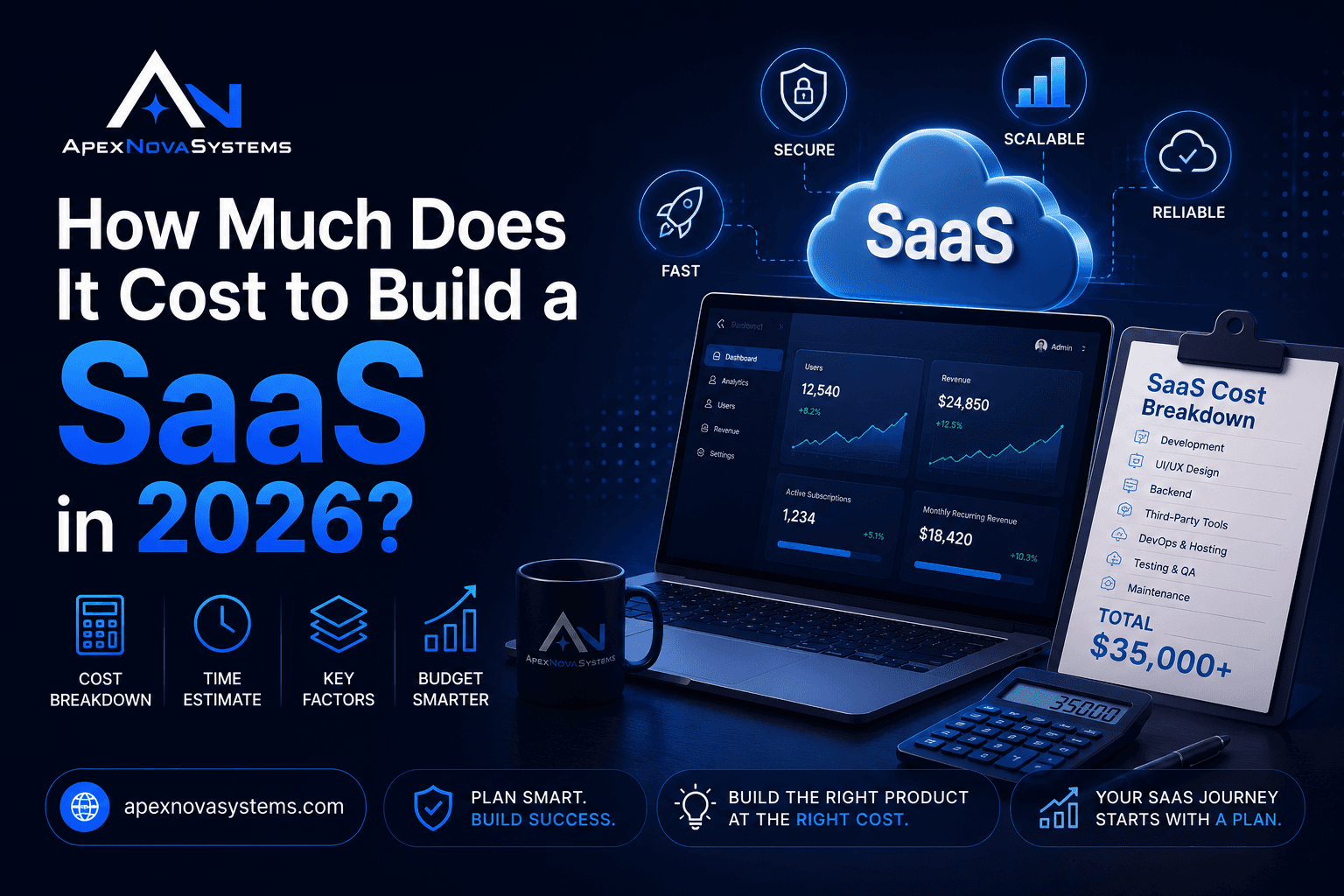
How Much Does It Cost to Build a SaaS in 2026?
Discover the complete cost breakdown for building a SaaS product in 2026, from $50K MVPs to $1M+ enterprise platforms. Learn budgeting strategies and cost-saving tips.
ApexNova Admin
Jul 7, 2026