How Much Does It Cost to Build a SaaS in 2026?
Discover the complete cost breakdown for building a SaaS product in 2026, from $50K MVPs to $1M+ enterprise platforms. Learn budgeting strategies and cost-saving tips.
ApexNova Admin
ApexNova team
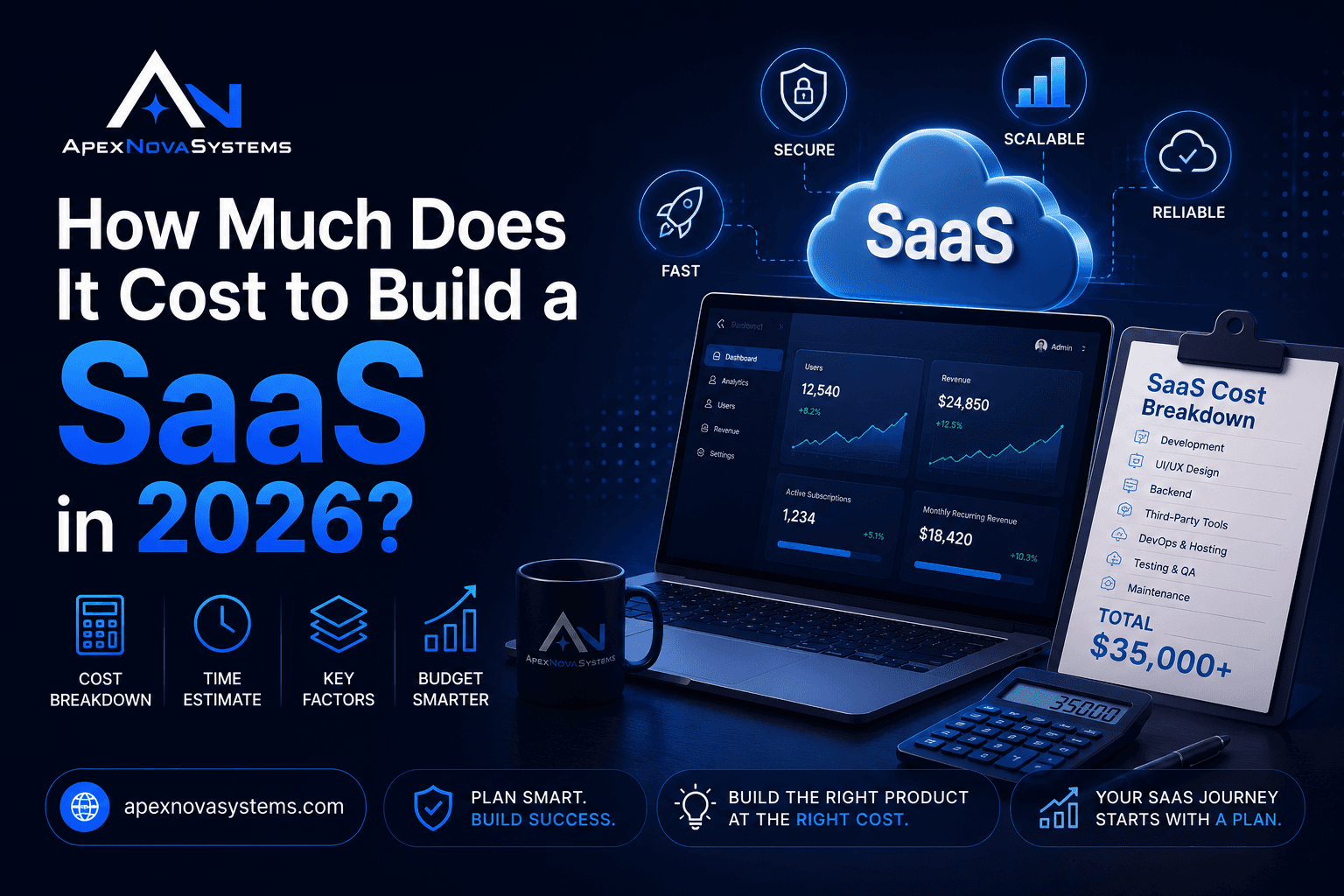
Building a Software-as-a-Service (SaaS) product in 2026 requires careful financial planning and a clear understanding of the various cost factors involved. Whether you're a startup founder or an established business looking to expand, knowing what to expect can help you budget effectively and avoid costly surprises.
Executive Summary
The cost to build a SaaS product in 2026 typically ranges from $50,000 to $500,000+ depending on complexity, features, and team composition. MVP (Minimum Viable Product) development can start as low as $30,000, while enterprise-grade platforms often exceed $1 million.
Key Cost Factors
1. Development Team Structure
Your choice of development team significantly impacts overall costs:
- Freelancers: $30 - $150/hour
- Most cost-effective for simple MVPs
- Requires strong project management
- Variable quality and availability
- Development Agency: $100 - $250/hour
- Full-service solution with project management
- Established processes and quality assurance
- Higher upfront costs but predictable delivery
- In-House Team: $80,000 - $180,000/year per developer
- Full control over product roadmap
- Long-term investment with ongoing salaries
- Includes benefits, equipment, and overhead
- Offshore Teams: $25 - $75/hour
- Lower hourly rates
- Time zone and communication challenges
- Quality varies significantly by provider
2. Product Complexity Tiers
Simple SaaS (3-6 months): $50,000 - $150,000
- Basic CRUD functionality
- Single user role
- Standard authentication
- Minimal integrations
- Examples: Task management tools, simple CRM
Medium Complexity (6-12 months): $150,000 - $350,000
- Multiple user roles and permissions
- Advanced data processing
- Payment integration
- API development
- Mobile responsiveness
- Examples: Project management platforms, marketing automation tools
Complex/Enterprise (12+ months): $350,000 - $1,000,000+
- Advanced security and compliance (SOC 2, HIPAA)
- Multi-tenancy architecture
- Real-time features and notifications
- Advanced analytics and reporting
- Third-party integrations ecosystem
- Mobile applications (iOS/Android)
- Examples: ERP systems, financial platforms, healthcare solutions
Detailed Cost Breakdown
Development Costs (60-70% of budget)
Frontend Development: $40,000 - $200,000
- User interface design implementation
- Responsive web application
- State management
- Client-side validation and logic
Backend Development: $50,000 - $250,000
- API architecture
- Database design and optimization
- Business logic implementation
- Server-side security
Mobile Apps (if applicable): $50,000 - $150,000 per platform
- iOS development
- Android development
- Cross-platform alternatives (React Native, Flutter)
Design Costs (10-15% of budget)
UI/UX Design: $15,000 - $80,000
- User research and personas
- Wireframing and prototyping
- Visual design system
- Usability testing
- Design system documentation
Infrastructure Costs (5-10% of budget)
Initial Setup: $5,000 - $25,000
- Cloud architecture setup (AWS, Google Cloud, Azure)
- DevOps and CI/CD pipeline
- Monitoring and logging systems
- Security infrastructure
Ongoing Monthly Costs: $500 - $10,000+
- Hosting and compute resources
- Database services
- CDN and storage
- Backup and disaster recovery
Quality Assurance (10-15% of budget)
Testing: $15,000 - $60,000
- Manual testing
- Automated test development
- Performance testing
- Security audits
- Bug fixing
Project Management (5-10% of budget)
Coordination: $10,000 - $40,000
- Sprint planning and management
- Stakeholder communication
- Documentation
- Risk management
Technology Stack Impact on Costs
Modern Stack Choices (2026)
Lower Cost Options:
- Next.js or React for frontend
- Node.js or Python for backend
- PostgreSQL or MongoDB for database
- Vercel or Railway for hosting
Enterprise Options (higher cost, more scalable):
- Microservices architecture
- Kubernetes orchestration
- GraphQL APIs
- Advanced caching layers (Redis, CDN)
- Data warehousing solutions
Hidden Costs to Consider
Compliance and Legal (Variable)
- Privacy policy and terms of service: $2,000 - $10,000
- GDPR compliance implementation: $10,000 - $50,000
- SOC 2 certification: $20,000 - $100,000+
- Legal consultation: $5,000 - $25,000
Third-Party Services
Essential Services (monthly):
- Email service (SendGrid, Postmark): $50 - $500
- Payment processing (Stripe, PayPal): 2.9% + $0.30 per transaction
- Analytics (Mixpanel, Amplitude): $0 - $2,000
- Customer support tools: $50 - $500
- Error tracking (Sentry): $26 - $500
Ongoing Maintenance (Annual)
Post-Launch: 15-20% of initial development cost
- Bug fixes and updates
- Security patches
- Performance optimization
- Infrastructure scaling
- Technical debt management
Cost-Saving Strategies
1. Start with MVP
Focus on core features that solve the primary user problem. Launch quickly and iterate based on real user feedback rather than assumptions.
Potential Savings: 40-60% compared to full-featured launch
2. Leverage Modern Tools and Frameworks
Use established frameworks and libraries instead of building from scratch:
- Authentication: Auth0, Clerk, Supabase Auth
- Payments: Stripe, Paddle
- Admin panels: Retool, Forest Admin
- Email: Ready-made templates and services
Potential Savings: $20,000 - $80,000
3. Use No-Code/Low-Code for Validation
Before committing to custom development, validate your idea with no-code tools like Bubble, Webflow, or Airtable.
Potential Savings: Can reduce validation costs by 80-90%
4. Open Source Solutions
Leverage open-source libraries and frameworks to avoid reinventing the wheel.
Potential Savings: $15,000 - $50,000
5. Strategic Outsourcing
Mix in-house strategic work with outsourced execution for non-core features.
Potential Savings: 25-40% on development costs
Regional Cost Variations
Development costs vary significantly by location:
- North America: $100 - $250/hour
- Western Europe: $80 - $200/hour
- Eastern Europe: $40 - $100/hour
- South Asia: $25 - $75/hour
- Latin America: $30 - $90/hour
Timeline Considerations
Development time directly impacts costs:
- MVP: 3-6 months = $50,000 - $150,000
- Full Product: 6-12 months = $150,000 - $400,000
- Enterprise Platform: 12-24 months = $400,000 - $1,500,000+
Real-World Examples
Case Study 1: Simple Productivity Tool
Budget: $75,000 Timeline: 4 months Team: 2 full-stack developers, 1 designer Features: Task management, team collaboration, basic reporting
Case Study 2: B2B Marketing Platform
Budget: $280,000 Timeline: 10 months Team: 5 developers, 2 designers, 1 PM, 1 QA Features: Multi-channel campaigns, analytics, integrations, user permissions
Case Study 3: Healthcare Compliance Platform
Budget: $850,000 Timeline: 18 months Team: 8 developers, 2 designers, 2 PMs, 2 QA, 1 security specialist Features: HIPAA compliance, patient data management, provider network, mobile apps, advanced security
Budgeting Best Practices
1. Add a Contingency Buffer
Always include 15-25% contingency for unexpected challenges, scope changes, and iterations.
2. Phase Your Investment
Break development into phases with clear milestones:
- Phase 1: Core MVP (40% of budget)
- Phase 2: Enhanced features (30% of budget)
- Phase 3: Scale and optimize (30% of budget)
3. Plan for Marketing
Reserve 30-50% of your development budget for marketing and customer acquisition. The best product won't succeed without users.
4. Consider Opportunity Cost
Factor in the time-to-market. Spending an extra $50,000 to launch 3 months earlier might generate significantly more revenue.
The True Cost: Beyond Development
Remember that development is just the beginning:
Year 1 Total Cost = Development + Operations + Marketing
A realistic Year 1 budget breakdown:
- Development: 50%
- Operations and infrastructure: 10%
- Marketing and sales: 30%
- Legal and administrative: 5%
- Contingency: 5%
When to Build vs. Buy
Consider using existing platforms if:
- Core features are commodity functions
- Time-to-market is critical
- Budget is limited
- The market is unproven
Build custom when:
- Your competitive advantage requires proprietary technology
- Specific compliance or security needs
- Long-term cost of licensing exceeds development
- Unique business processes require customization
Conclusion
Building a SaaS product in 2026 requires a strategic investment ranging from $50,000 for a basic MVP to over $1 million for enterprise-grade solutions. The key to success is starting lean, validating assumptions quickly, and scaling based on real user feedback and market demand.
Focus on solving a genuine problem for your target users, invest in quality development and design, and plan for ongoing costs beyond the initial launch. With careful planning and strategic execution, you can build a sustainable SaaS business that delivers value to customers and returns to stakeholders.
Remember: the most expensive SaaS product is one that nobody uses. Invest wisely in understanding your market, building the right features, and creating an exceptional user experience.
Discussion(0)
Sign in to comment with your account, or fill in your name below as a guest.
Continue reading
Browse all → Engineering
When AI Agents Make Mistakes: The New Reality of Autonomous Systems in the Workplace
As AI systems evolve from chatbots to autonomous agents, organizations must prepare for inevitable mistakes. Learn how to build resilient systems that can fail safely and recover quickly.

Arman Ali
Jul 21, 2026
 Engineering
Why We Built Our Own PDF Toolkit In-House — And Made It Free
Free, browser-based PDF tools built with privacy first. No ads, no uploads to unknown servers, no paywalls. Convert, merge, compress, and edit PDFs—plus AI-powered summaries.
Zeeshan
Jul 8, 2026
 Engineering
How Solo Developers Are Building Million-Dollar Startups with AI
AI tools enable solo developers to build million-dollar startups without teams. Learn the tech stack, strategies, and playbook successful founders use to scale.
Arman Ali
Jul 1, 2026