MCP (Model Context Protocol): The New Standard for AI Apps
MCP (Model Context Protocol) is transforming AI development by providing a universal standard for connecting AI systems to data sources and tools, eliminating the N×M integration problem.

Arman Ali
I specialize in building and maintaining scalable web applications, with a strong focus on performance, user experience, and backend efficiency. With over 4+ years of experience, I have evolved from a front-end expert into a full-stack developer proficient in both front-end and back-end development.
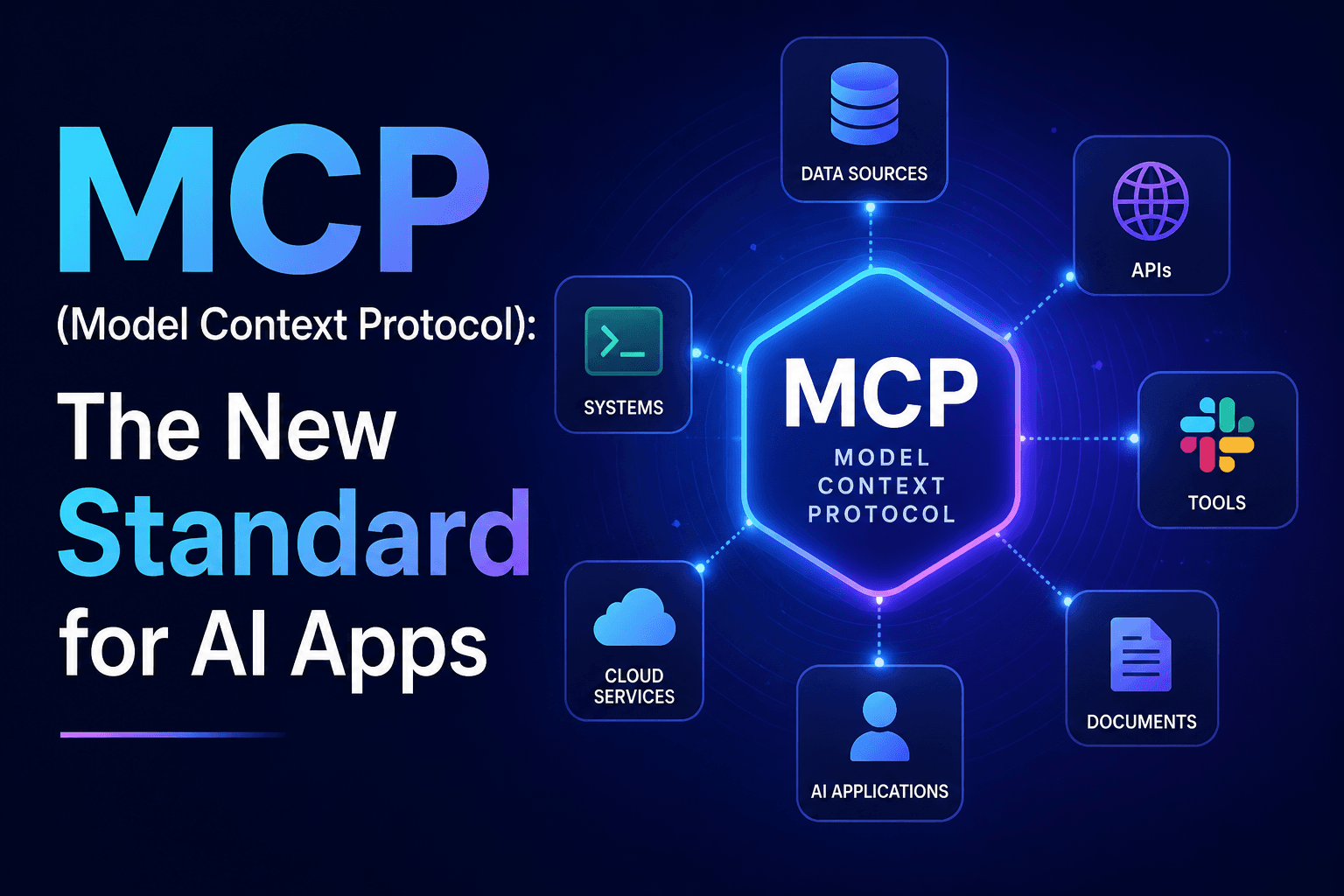
The landscape of AI application development has fundamentally changed. As artificial intelligence systems become more sophisticated, the challenge isn't just building smarter models—it's connecting them to the data and tools they need to be genuinely useful. Enter the Model Context Protocol (MCP), an open standard that's rapidly becoming the universal interface for AI integrations.
The Integration Problem MCP Solves
Before MCP, every AI application faced the same exhausting reality: building custom connectors for each data source, API, or tool. Want your AI assistant to access a database? Write a custom integration. Need it to connect to a business tool? Build another one. This created what Anthropic calls the "N×M problem"—N AI applications each requiring M separate integrations, resulting in exponentially growing complexity.
The result was predictable: fragmented ecosystems, duplicated effort, and AI systems that could never reach their full potential because connecting them to the real world was simply too expensive.
What Is MCP?
Introduced by Anthropic in November 2024, the Model Context Protocol is an open standard that provides a universal interface for connecting AI systems to external data sources and tools. Think of it as USB-C for AI applications—a single, standardized connection that works everywhere.
MCP replaces vendor-specific, one-off integrations with a common protocol that any AI system can use to:
- Access data from content repositories and databases
- Execute functions and interact with APIs
- Read files and system resources
- Handle contextual prompts
The protocol was created by Anthropic engineers David Soria Parra and Justin Spahr-Summers and was released with SDKs in Python, TypeScript, Java, C#, and multiple other languages. Following its announcement, MCP saw rapid adoption across the industry, with OpenAI officially integrating it into ChatGPT in March 2025 and Google DeepMind following suit shortly after.
How MCP Works: Architecture and Core Concepts
MCP uses a straightforward host-client-server architecture built on JSON-RPC 2.0:
MCP Servers expose capabilities—tools, resources, and prompts—that AI systems can discover and use. These servers can be built by anyone and run locally or remotely.
MCP Clients are AI-powered applications that connect to these servers, discover available capabilities, and invoke them on behalf of users or autonomous agents.
Hosts manage the connection between clients and servers, handling authentication, transport, and lifecycle management.
The Three Core Primitives
MCP defines three fundamental building blocks:
- Tools (model-controlled): Functions that the AI model can call directly during inference. These allow models to take actions like querying databases, calling APIs, or executing calculations.
- Resources (application-controlled): Data sources that applications can explicitly provide to the model. These include files, database records, or any structured content the AI needs to reference.
- Prompts (user-controlled): Reusable prompt templates that guide how users interact with specific capabilities, providing consistency and best practices.
This three-primitive design gives developers fine-grained control over how AI systems access and interact with external capabilities.
Real-World Impact and Adoption
The adoption curve for MCP has been remarkable. Within 18 months of launch:
- Major AI providers including OpenAI, Google DeepMind, and Microsoft integrated MCP support
- OpenAI added MCP support to ChatGPT desktop apps in September 2025
- The protocol was donated to the Agentic AI Foundation (AAIF) for vendor-neutral governance
- The AAIF held the first MCP Dev Summit in New York City in April 2026, drawing over 1,200 attendees
Developers can now build an MCP server once and have it work seamlessly across Claude, ChatGPT, and other MCP-compatible platforms. This composability is transforming how teams approach AI integration.
MCP in the Multi-Agent Ecosystem
By 2026, MCP has found its place alongside complementary protocols like Google's Agent-to-Agent (A2A) protocol. While MCP handles the "agent calls a tool" pattern, A2A manages "agent calls another agent" scenarios.
The distinction is crucial for architects building complex AI systems:
- Use MCP when your AI needs to access external tools, databases, or APIs in a standardized way
- Use A2A when multiple autonomous agents need to coordinate, delegate tasks, and communicate as peers
- Use both in sophisticated architectures where agents collaborate with each other (A2A) while individually accessing tools and data (MCP)
This separation of concerns allows teams to build scalable, interoperable AI systems without reinventing the wheel for every integration point.
Getting Started with MCP
Building with MCP is straightforward:
For server developers: Use the official SDKs to expose your tools and resources. Define capabilities using simple decorators (in Python) or interface definitions (in TypeScript), and MCP handles discovery, authentication, and transport.
For client developers: Connect to MCP servers using the client SDK. Your AI application can discover available tools, present them to users, and invoke them when needed—all through a consistent interface.
For users: Popular AI tools like Claude Desktop and ChatGPT already support MCP servers out of the box. Install or configure the servers you need, and your AI assistant gains immediate access to new capabilities.
The official documentation, SDKs, and reference implementations are available at modelcontextprotocol.io.
Why MCP Matters
MCP represents a fundamental shift in how we think about AI application development. Instead of building isolated systems that require constant custom work to connect to the world, developers can now build on a common foundation that grows more valuable with every new integration.
The protocol solves the integration problem once, allowing teams to focus on what actually matters: building AI experiences that deliver real value. As the ecosystem matures and more MCP servers become available, the compound effect will accelerate—every new server benefits every MCP-compatible application.
For organizations evaluating AI infrastructure, MCP offers a future-proof approach. Build your integrations once using an open standard, and they'll work across current and future AI platforms. That's not just convenient—it's strategic.
The Path Forward
The standardization of AI tool integration through MCP marks a turning point for the industry. Combined with emerging standards like A2A for agent coordination and improved structured output handling, we're seeing the formation of a mature, interoperable AI application ecosystem.
For developers, the message is clear: MCP isn't just another protocol to learn—it's becoming the standard way AI systems connect to the world. Whether you're building AI-powered tools, integrating data sources, or creating autonomous agents, understanding and implementing MCP will be essential.
The future of AI applications is connected, composable, and built on open standards. MCP is how we get there.
Ready to start building with MCP? Visit modelcontextprotocol.io to explore the specification, download SDKs, and connect with the growing community of developers shaping the future of AI integration.
Written by
Arman Ali
I specialize in building and maintaining scalable web applications, with a strong focus on performance, user experience, and backend efficiency. With over 4+ years of experience, I have evolved from a front-end expert into a full-stack developer proficient in both front-end and back-end development.
Discussion(0)
Sign in to comment with your account, or fill in your name below as a guest.
Continue reading
Browse all → Engineering
When AI Agents Make Mistakes: The New Reality of Autonomous Systems in the Workplace
As AI systems evolve from chatbots to autonomous agents, organizations must prepare for inevitable mistakes. Learn how to build resilient systems that can fail safely and recover quickly.
Arman Ali
Jul 21, 2026
 Engineering
Why We Built Our Own PDF Toolkit In-House — And Made It Free
Free, browser-based PDF tools built with privacy first. No ads, no uploads to unknown servers, no paywalls. Convert, merge, compress, and edit PDFs—plus AI-powered summaries.
Zeeshan
Jul 8, 2026
 Engineering
How Much Does It Cost to Build a SaaS in 2026?
Discover the complete cost breakdown for building a SaaS product in 2026, from $50K MVPs to $1M+ enterprise platforms. Learn budgeting strategies and cost-saving tips.
ApexNova Admin
Jul 7, 2026