The Rise of Agentic AI: What Developers Need to Learn
Agentic AI systems can reason, plan, and execute complex workflows autonomously. Learn the essential skills developers need to build and work with these powerful systems.

Arman Ali
I specialize in building and maintaining scalable web applications, with a strong focus on performance, user experience, and backend efficiency. With over 4+ years of experience, I have evolved from a front-end expert into a full-stack developer proficient in both front-end and back-end development.
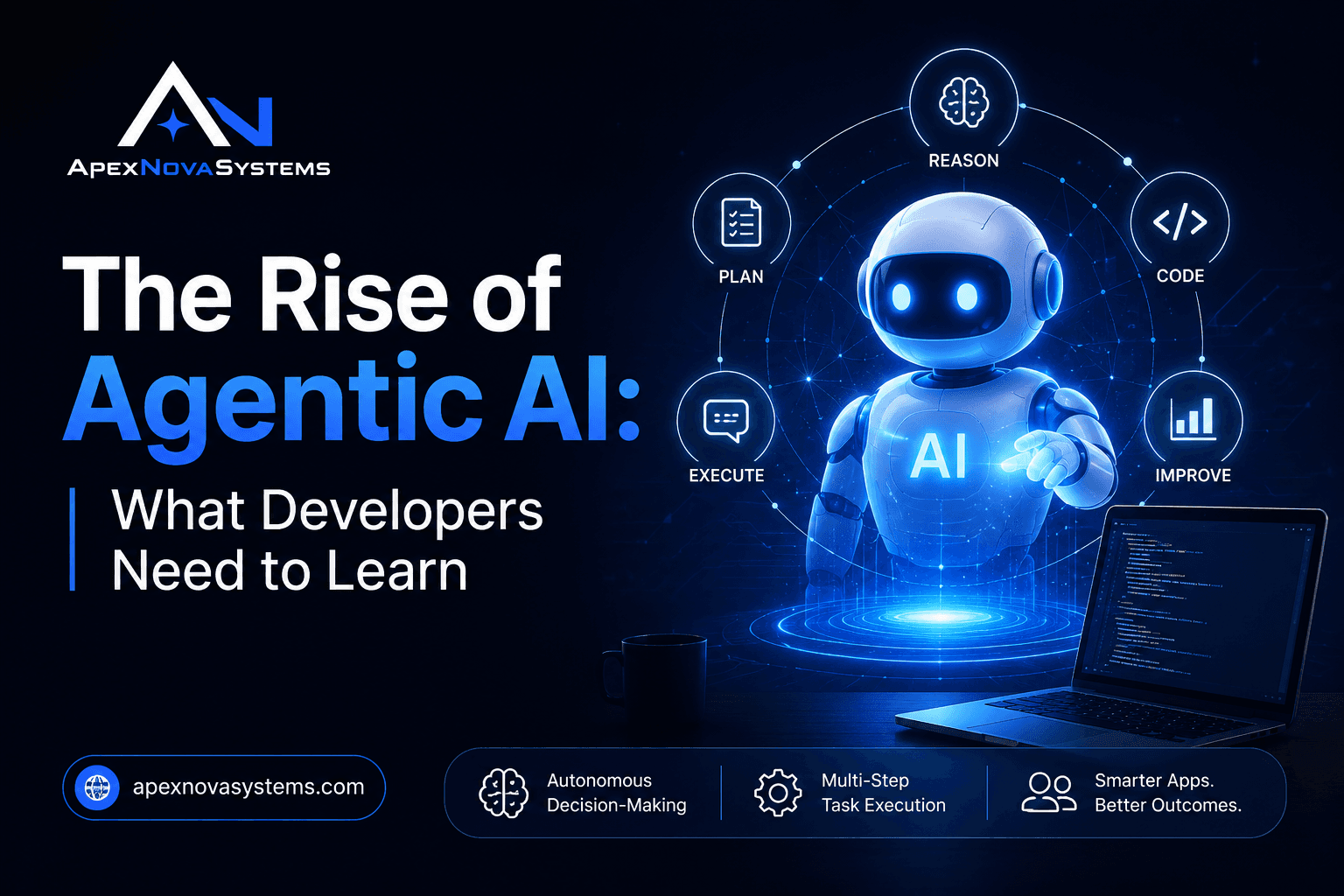
The artificial intelligence landscape is undergoing a fundamental shift. While traditional AI systems have excelled at narrow, well-defined tasks, a new paradigm is emerging: agentic AI—systems that can reason, plan, and execute complex workflows with minimal human intervention. For developers, this transition represents both an exciting opportunity and a significant learning challenge.
Understanding Agentic AI
Agentic AI refers to autonomous systems capable of:
- Goal-directed behavior: Understanding high-level objectives and breaking them down into actionable steps
- Dynamic planning: Adapting strategies based on changing circumstances and feedback
- Tool use: Leveraging external APIs, databases, and services to accomplish tasks
- Memory and context: Maintaining state across interactions to inform future decisions
- Self-correction: Identifying errors and iteratively improving outputs
Unlike traditional AI models that simply respond to prompts, agentic systems can pursue goals independently, making them more powerful—and more complex to build and manage.
Why Agentic AI Matters Now
Several converging factors have made agentic AI practical and necessary:
Advances in Foundation Models
Large language models like GPT-4, Claude, and others have developed reasoning capabilities that enable multi-step problem-solving. These models can now understand context, follow instructions, and generate code that works—not just code that looks plausible.
The Limits of Static Automation
Traditional automation requires developers to anticipate every edge case and code explicit logic for each scenario. Agentic systems can handle unexpected situations by reasoning through problems dynamically, dramatically reducing development overhead.
Rising Complexity in Software Systems
Modern applications integrate dozens of services, APIs, and data sources. Agentic AI can navigate this complexity more effectively than rigid rule-based systems, orchestrating across multiple tools to accomplish user goals.
Core Skills Developers Need to Master
Building and working with agentic AI systems requires a new skill set that bridges traditional software engineering with AI capabilities.
1. Prompt Engineering and LLM Interaction
Understanding how to communicate effectively with language models is foundational:
- Structured prompting: Designing clear, unambiguous instructions that guide AI behavior
- Few-shot learning: Providing examples to demonstrate desired output patterns
- Chain-of-thought reasoning: Encouraging models to show their work and reasoning steps
- System messages and personas: Setting context and constraints for AI behavior
2. Orchestration and Workflow Design
Agentic systems require careful orchestration of multiple components:
- Task decomposition: Breaking complex goals into manageable sub-tasks
- Execution graphs: Defining dependencies and parallel execution paths
- Error handling and recovery: Building resilient systems that gracefully handle failures
- State management: Tracking context and progress across multi-step workflows
3. Tool Integration and Function Calling
Modern agentic systems extend LLM capabilities through external tools:
- API design for AI agents: Creating clear, discoverable interfaces that agents can understand
- Function schemas: Defining tool capabilities in structured formats (JSON Schema, OpenAPI)
- Parameter validation: Ensuring agents provide valid inputs to external systems
- Rate limiting and safety: Protecting resources from misuse or runaway execution
4. Evaluation and Testing
Traditional unit tests aren't sufficient for non-deterministic AI systems:
- LLM-as-judge evaluation: Using AI to assess the quality of AI outputs
- Golden dataset creation: Building representative test cases for common scenarios
- Human-in-the-loop review: Identifying failure modes through user feedback
- A/B testing: Comparing agent performance across different configurations
5. Safety and Alignment
As agents gain autonomy, safety becomes critical:
- Sandboxing and permissions: Restricting agent access to sensitive systems
- Output filtering: Preventing harmful or inappropriate responses
- Audit logging: Tracking agent decisions for debugging and compliance
- Fallback strategies: Ensuring graceful degradation when agents can't complete tasks
Practical Frameworks and Tools
The agentic AI ecosystem is rapidly maturing with production-ready frameworks:
Agent Frameworks
- LangChain and LangGraph: Building complex agent workflows with state management
- AutoGPT and BabyAGI: Autonomous agents that plan and execute multi-step tasks
- Semantic Kernel: Microsoft's SDK for integrating AI into applications
- Anthropic Computer Use: Agents that can interact with computer interfaces directly
Vector Databases and Memory
- Pinecone, Weaviate, Qdrant: Storing and retrieving relevant context efficiently
- RAG (Retrieval-Augmented Generation): Grounding agent responses in specific knowledge
- Long-term memory patterns: Maintaining conversation history and learned preferences
Observability and Monitoring
- LangSmith, Weights & Biases: Tracking agent performance and debugging failures
- Prompt versioning: Managing and testing prompt changes over time
- Cost monitoring: Tracking API usage and optimizing for efficiency
Architectural Patterns for Agentic Systems
Successful agentic AI implementations typically follow proven patterns:
The ReAct Pattern (Reason + Act)
Agents alternate between reasoning about what to do next and taking actions:
- Thought: Analyze the current situation and decide on next steps
- Action: Execute a tool or API call
- Observation: Process the result
- Repeat: Continue until the goal is achieved
Multi-Agent Collaboration
Complex tasks often benefit from specialized agents working together:
- Orchestrator agents: Coordinate work between specialized sub-agents
- Expert agents: Focus on specific domains (code generation, data analysis, writing)
- Verification agents: Review outputs from other agents for quality and accuracy
Human-in-the-Loop (HITL)
For high-stakes decisions, incorporate human oversight:
- Approval gates: Require human confirmation before executing critical actions
- Active learning: Flag uncertain cases for human review and training
- Feedback loops: Continuously improve agent performance based on corrections
Challenges and Considerations
Despite their promise, agentic AI systems present unique challenges:
Unpredictability and Debugging
Non-deterministic behavior makes traditional debugging approaches insufficient. Developers must embrace probabilistic thinking and build robust monitoring to understand agent behavior.
Cost Management
Multiple LLM calls per task can quickly become expensive. Optimizing for efficiency—through caching, smaller models for simple tasks, and smart prompt design—is essential.
Security and Trust
Agents that can execute code or access APIs introduce new attack vectors. Input validation, sandboxing, and least-privilege principles are critical.
Latency and User Experience
Multi-step reasoning takes time. Applications must communicate progress to users and consider streaming responses or background execution.
Getting Started: A Learning Path
For developers ready to explore agentic AI, here's a suggested progression:
- Experiment with prompting: Use ChatGPT, Claude, or other LLMs to understand their capabilities and limitations
- Build a simple tool-using agent: Create an agent that can call APIs or search documentation
- Implement RAG: Add retrieval capabilities to ground agent responses in specific knowledge
- Design a multi-step workflow: Build an agent that can plan and execute a sequence of actions
- Add evaluation: Create test cases and measure agent performance systematically
- Deploy in production: Start with low-risk use cases and expand as you build confidence
The Future of Development
Agentic AI isn't replacing developers—it's changing what development means. The focus is shifting from writing every line of code to designing systems, setting objectives, and ensuring quality outcomes.
The developers who thrive in this new paradigm will be those who combine software engineering fundamentals with an understanding of AI capabilities and limitations. They'll design systems that leverage autonomous agents while maintaining control, safety, and reliability.
The rise of agentic AI represents a profound shift in how we build software. The question isn't whether to learn these skills, but how quickly you can start applying them to create more powerful, intelligent applications.
Ready to explore agentic AI in your projects? Start by identifying repetitive, multi-step workflows in your applications that could benefit from autonomous decision-making. The future of development is autonomous, adaptive, and agent-driven.
Written by
Arman Ali
I specialize in building and maintaining scalable web applications, with a strong focus on performance, user experience, and backend efficiency. With over 4+ years of experience, I have evolved from a front-end expert into a full-stack developer proficient in both front-end and back-end development.
Discussion(0)
Sign in to comment with your account, or fill in your name below as a guest.
Continue reading
Browse all → Engineering
When AI Agents Make Mistakes: The New Reality of Autonomous Systems in the Workplace
As AI systems evolve from chatbots to autonomous agents, organizations must prepare for inevitable mistakes. Learn how to build resilient systems that can fail safely and recover quickly.
Arman Ali
Jul 21, 2026
 Engineering
Why We Built Our Own PDF Toolkit In-House — And Made It Free
Free, browser-based PDF tools built with privacy first. No ads, no uploads to unknown servers, no paywalls. Convert, merge, compress, and edit PDFs—plus AI-powered summaries.
Zeeshan
Jul 8, 2026
 Engineering
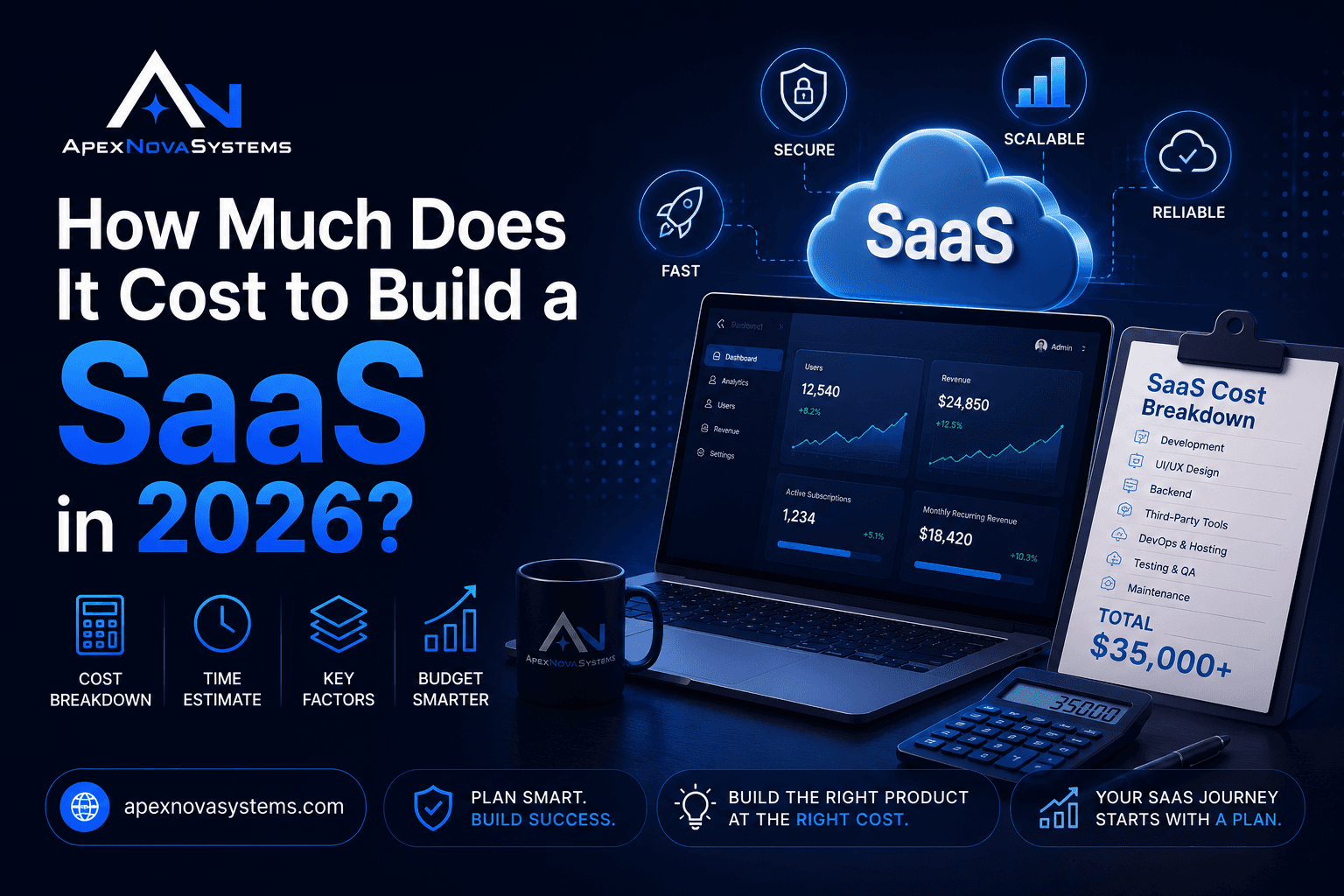
How Much Does It Cost to Build a SaaS in 2026?
Discover the complete cost breakdown for building a SaaS product in 2026, from $50K MVPs to $1M+ enterprise platforms. Learn budgeting strategies and cost-saving tips.
ApexNova Admin
Jul 7, 2026