How AI Is Transforming Full-Stack Development
Artificial intelligence is revolutionizing full-stack development, accelerating productivity, democratizing complex tasks, and reshaping the skills required for modern web development.

Arman Ali
I specialize in building and maintaining scalable web applications, with a strong focus on performance, user experience, and backend efficiency. With over 4+ years of experience, I have evolved from a front-end expert into a full-stack developer proficient in both front-end and back-end development.
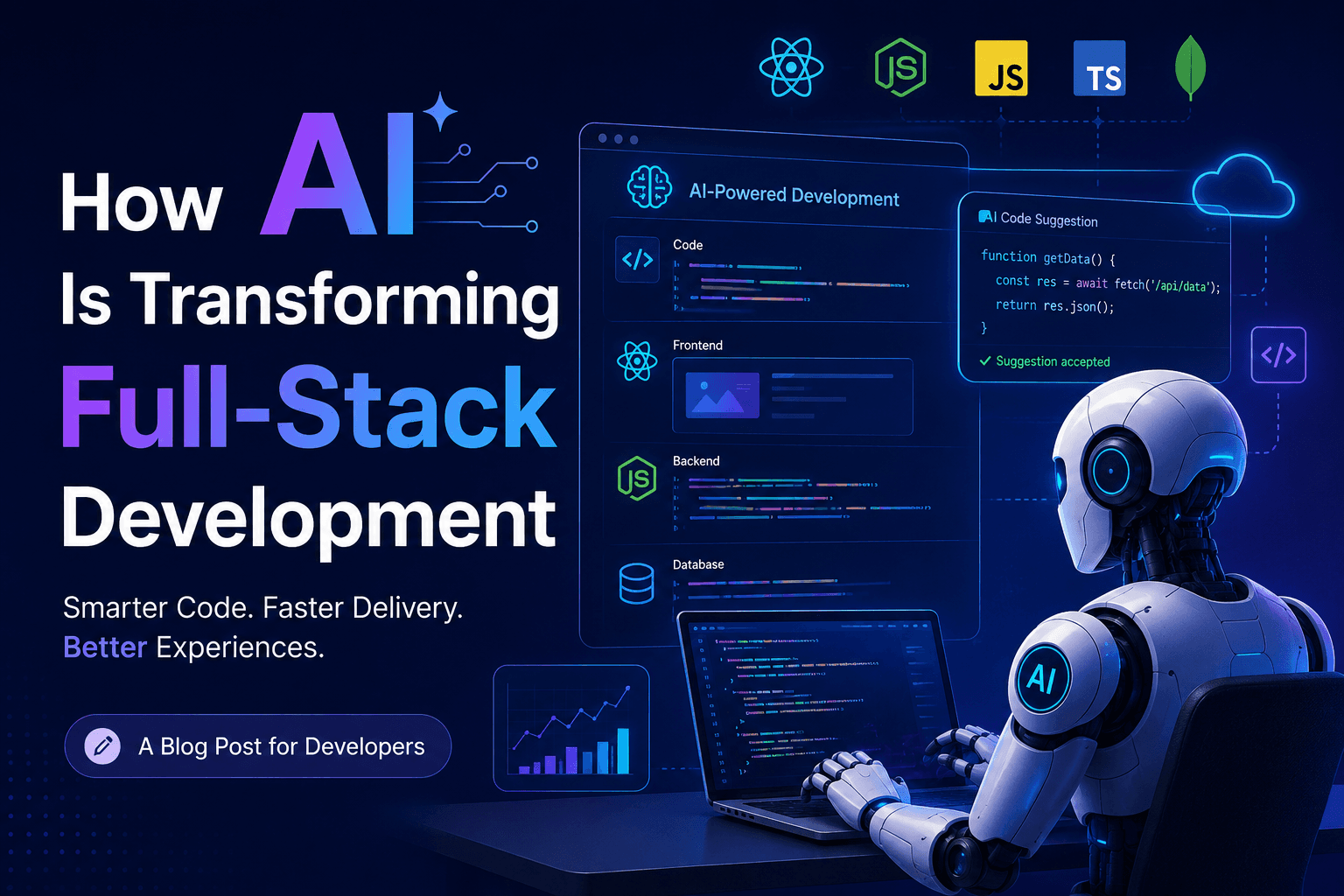
The landscape of full-stack development is undergoing a fundamental shift. Artificial intelligence has moved from experimental novelty to essential tooling, fundamentally changing how developers approach both front-end and back-end challenges. This transformation is accelerating productivity, democratizing complex tasks, and reshaping the skills required for modern web development.
The New Developer Workflow
AI-powered coding assistants have become integral to the daily workflow of full-stack developers. These tools offer context-aware code suggestions, complete entire functions, and even generate boilerplate code across multiple files. What once required hours of repetitive typing now happens in seconds, allowing developers to focus on architecture and business logic rather than syntax and implementation details.
The impact extends beyond simple autocomplete. Modern AI tools understand project structure, coding patterns, and best practices specific to frameworks and languages. They can refactor legacy code, identify potential bugs before they reach production, and suggest performance optimizations that might otherwise go unnoticed.
Accelerated Learning and Skill Development
For developers expanding their full-stack capabilities, AI serves as an on-demand mentor. Learning a new framework, database system, or deployment strategy no longer requires extensive documentation diving or tutorial consumption. AI assistants provide real-time explanations, working code examples, and immediate answers to specific implementation questions.
This acceleration is particularly valuable when working across the stack. A developer comfortable with React but unfamiliar with database optimization can receive targeted guidance without leaving their development environment. The barrier between front-end and back-end expertise continues to lower as AI fills knowledge gaps in real time.
Intelligent Code Review and Quality Assurance
AI-driven code analysis tools now provide sophisticated review capabilities that extend far beyond traditional linters. These systems identify security vulnerabilities, detect anti-patterns, assess code complexity, and suggest architectural improvements. They learn from millions of repositories to recognize common pitfalls and recommend proven solutions.
Key benefits include:
- Automated security scanning that catches injection vulnerabilities, authentication flaws, and data exposure risks
- Performance analysis identifying inefficient queries, unnecessary re-renders, and memory leaks
- Accessibility auditing ensuring front-end code meets WCAG standards
- Consistency enforcement maintaining coding standards across large teams and codebases
Database Design and Query Optimization
Working with databases has traditionally been one of the more challenging aspects of full-stack development. AI tools now assist with schema design, suggesting optimal table structures, indexing strategies, and relationships based on application requirements. They can translate natural language descriptions into working SQL queries and identify inefficient database calls in application code.
For developers working with ORMs, AI helps bridge the gap between object-oriented code and relational databases, suggesting efficient query patterns and identifying N+1 problems before they impact production performance.
API Development and Integration
Building robust APIs requires careful consideration of endpoints, authentication, validation, and documentation. AI accelerates this process by generating OpenAPI specifications, creating middleware, implementing authentication flows, and even writing comprehensive API tests.
When integrating third-party services, AI tools can read documentation and generate working integration code complete with error handling and retry logic. This dramatically reduces the time required to connect services and allows developers to prototype integrations rapidly.
Front-End Intelligence
On the front-end, AI assists with responsive design, accessibility compliance, and component architecture. Tools can convert design mockups into working code, suggest optimal component hierarchies, and generate CSS that works across browsers and devices.
Advanced AI systems analyze user interaction patterns to suggest UX improvements, identify confusing navigation flows, and recommend performance optimizations for faster page loads. They can also generate realistic test data and user personas for development and testing.
DevOps and Deployment Automation
Full-stack developers increasingly handle deployment and infrastructure concerns. AI-powered DevOps tools simplify this complexity by generating Docker configurations, Kubernetes manifests, and CI/CD pipelines tailored to specific application requirements.
These systems can:
- Analyze application dependencies and suggest optimal container strategies
- Identify resource bottlenecks and recommend scaling approaches
- Automate monitoring setup and alert configuration
- Generate infrastructure-as-code templates for cloud providers
Testing at Scale
Writing comprehensive tests remains time-consuming but critical. AI tools now generate unit tests, integration tests, and end-to-end test suites based on existing code. They identify edge cases that developers might miss and ensure test coverage across the entire stack.
More sophisticated systems can generate synthetic test data that matches production patterns, create visual regression tests for UI components, and even write tests that verify business logic correctness.
The Changing Skill Set
As AI handles more implementation details, the skills that differentiate exceptional full-stack developers are shifting. Deep understanding of system architecture, security principles, and user experience design becomes more valuable than memorizing framework APIs or language syntax.
Developers who effectively leverage AI focus on:
- System design and architecture – Making high-level decisions about structure and scalability
- Problem decomposition – Breaking complex requirements into clear specifications
- Critical evaluation – Reviewing AI-generated code for correctness and optimization
- Domain expertise – Understanding business logic and user needs
- Security awareness – Identifying vulnerabilities AI tools might miss
Challenges and Considerations
While AI brings tremendous benefits, it introduces new considerations. Developers must remain vigilant about code quality, as AI suggestions aren't always optimal or secure. Over-reliance on AI assistance can lead to shallow understanding of underlying systems, potentially creating maintenance challenges.
Organizations must also consider:
- Code ownership and licensing implications of AI-generated code
- Training developers to effectively prompt and evaluate AI tools
- Maintaining coding standards when multiple AI tools contribute to a codebase
- Security review processes for AI-generated code
Looking Forward
AI's role in full-stack development will continue expanding. Future systems will handle increasingly complex tasks, from automated performance optimization to intelligent database query planning. Natural language interfaces will allow less technical stakeholders to contribute to application logic and data modeling.
The most successful developers will be those who embrace AI as a collaborative tool while maintaining deep technical expertise. AI augments human capability rather than replacing it, allowing developers to tackle more ambitious projects and deliver higher-quality software faster.
Conclusion
AI has fundamentally altered the full-stack development landscape, transforming workflows, accelerating learning, and enabling developers to work more efficiently across the entire technology stack. While challenges remain, the trajectory is clear: AI-assisted development is becoming the standard, not the exception.
For development teams and individual developers, the question is no longer whether to adopt AI tools, but how to integrate them most effectively into existing workflows. Those who successfully navigate this transition will find themselves capable of building more sophisticated applications with greater speed and reliability than ever before.
The future of full-stack development is collaborative – human creativity and strategic thinking augmented by AI's pattern recognition and implementation speed. This partnership promises to unlock new possibilities in software development and fundamentally reshape what's possible for teams of any size.
Written by
Arman Ali
I specialize in building and maintaining scalable web applications, with a strong focus on performance, user experience, and backend efficiency. With over 4+ years of experience, I have evolved from a front-end expert into a full-stack developer proficient in both front-end and back-end development.
Discussion(0)
Sign in to comment with your account, or fill in your name below as a guest.
Continue reading
Browse all → Engineering
When AI Agents Make Mistakes: The New Reality of Autonomous Systems in the Workplace
As AI systems evolve from chatbots to autonomous agents, organizations must prepare for inevitable mistakes. Learn how to build resilient systems that can fail safely and recover quickly.
Arman Ali
Jul 21, 2026
 Engineering
Why We Built Our Own PDF Toolkit In-House — And Made It Free
Free, browser-based PDF tools built with privacy first. No ads, no uploads to unknown servers, no paywalls. Convert, merge, compress, and edit PDFs—plus AI-powered summaries.
Zeeshan
Jul 8, 2026
 Engineering
How Much Does It Cost to Build a SaaS in 2026?
Discover the complete cost breakdown for building a SaaS product in 2026, from $50K MVPs to $1M+ enterprise platforms. Learn budgeting strategies and cost-saving tips.
ApexNova Admin
Jul 7, 2026